
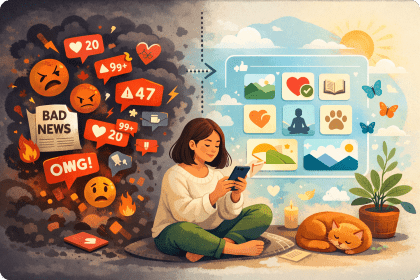
In a world of nonstop scrolling, social media burnout recovery has become a quiet survival skill rather than a luxury. Many people wake up, tap into several apps before even getting out of bed, and end the day with the same overstimulated brain and overstimulated and under-rested nervous system. If feeds are full of drama, comparison, and bad news, burnout is not a personal weakness; it is a predictable response to chronic digital overload.
The good news is that you can rebuild your online space into something that protects your mental health instead of draining it by practicing intentional feed curation. Small shifts in who you follow, how you engage, and how often you log on can start to heal digital exhaustion and create a more peaceful relationship with your phone.
This transition from passive scrolling to active curation is a powerful act of digital boundaries. It’s important to remember that your attention is a finite resource, a form of currency that social media platforms are designed to spend for you. When you reclaim that currency, you aren’t just cleaning up an app; you are deciding what kind of information is allowed to influence your mood, your self image, and your peace of mind. By treating your digital environment with the same care you would treat your physical home, you create a sanctuary where you can connect and learn without the heavy cost of emotional depletion.
What Is Social Media Burnout, Really?
Psychologists describe chronic social scroll fatigue as a state where emotional and mental energy is depleted by constant online engagement. Instead of feeling connected or entertained, you feel numb, irritable, or strangely hollow after spending time on apps. Research links heavy, compulsive social media use with increased anxiety, depression, insomnia, and loneliness, especially when people use multiple platforms for long periods.
At the brain level, every like, every notification, and every update can trigger the stress response and dopamine systems repeatedly, eventually leading to emotional exhaustion and detachment. When compulsive use continues despite these symptoms, it becomes a cycle of problematic social media use that quietly erodes focus, mood, and self-esteem.
This erosion of self esteem often stems from upward social comparison, where we subconsciously measure our messy, behind the scenes reality against everyone else’s polished, high definition highlight reels. When the brain is constantly flooded with these curated images, it begins to register your normal, everyday life as inadequate, leading to a persistent sense of not being enough. This digital fatigue also impairs your prefrontal cortex, the area of the brain responsible for impulse control and decision making which explains why, when you are most burnt out, you often find yourself scrolling even more. Your brain is essentially looking for a dopamine fix to soothe the very exhaustion the apps created, locking you into a feedback loop that requires an intentional, compassionate intervention to break.
Early Signs You Need a Digital Reset
Recognizing early social burnout symptoms helps you intervene before you reach complete emotional shutdown. Common warning signs include feeling more anxious or low after scrolling, losing motivation for offline activities, and struggling to sleep because your mind is replaying online content.
You might notice that you keep checking apps even when they no longer feel enjoyable, reaching for your phone whenever there is a small pause in your day. Many people also report comparison-driven mood drops, where seeing other people’s highlight reels makes their own life feel smaller and less successful.
Beyond the emotional toll, these symptoms often manifest as a brain fog that makes simple real world tasks feel unnecessarily taxing. You might find it harder to focus on a book, hold a long conversation, or even finish a meal without the phantom itch to check for a notification. This is your nervous system signaling that it is stuck in a state of hyper vigilance, constantly scanning for social validation or “FOMO” (Fear Of Missing Out). When your phone becomes a reflex rather than a tool, your internal compass for joy and presence begins to glitch. Recognizing these red flags isn’t about shaming yourself for your screen time; it’s about noticing that your digital input has officially exceeded your emotional output capacity.
Why Curating Your Feed Changes Your Mood
Your feed is not neutral; it is a curated stream of inputs that shapes how you feel about yourself and the world. When that stream is filled with unrealistic standards, conflict, and pressure, it becomes emotionally toxic. By practicing mental health focused feed design, you choose which ideas, images, and voices occupy your attention each day.
Therapists increasingly recommend supportive content curation as a practical tool for anxiety and depression management. Removing triggering or perfectionist accounts and replacing them with validating, educational, or calming content reduces daily psychological stress and can support healthier self-talk.
This shift in your digital environment acts as a guardrail for your mental health, protecting you from the constant barrage of comparison. When your feed is intentionally designed to include diverse body types, realistic career paths, and messages of self compassion, you are essentially providing your brain with a more balanced and honest view of reality. This reduces the frequency of shame spirals and helps quiet the inner critic that thrives on the perfectionism often found in uncurated spaces. By surrounding yourself with content that reflects your values and acknowledges your struggles without judgment, you transform your phone from a source of stress into a tool for affirmation.
Step 1: Start a Gentle Feed Audit
The first step in mindful timeline detox is not deleting everything; it is noticing how each part of your feed makes you feel. For a few days, pay attention to your body and mood before, during, and after scrolling on a platform. Ask yourself which posts leave you tense, jealous, or ashamed, and which ones help you feel grounded, inspired, or understood.
You can keep a simple note on your phone titled emotional feed check-in and list accounts under “drains me” or “supports me.” This awareness alone often reveals that a small handful of accounts are responsible for most of your emotional spikes and exhaustion.
This list often acts as a mirror, reflecting the digital clutter that has been weighing down your subconscious without your permission. When you see the names written down, you realize that your exhaustion isn’t a vague, unfixable cloud, but a specific reaction to certain inputs. This realization is incredibly empowering because it moves you from a place of passive suffering to active choice. You begin to understand that you don’t have to be a hostage to your algorithm. Identifying these specific drains is the moment you stop letting the app’s developers decide your mood and start reclaiming your mental energy for the things that actually nourish your life.
Step 2: Protect Yourself with Boundaries Tools
Once you identify draining accounts, use platform tools to create a low-toxicity social feed. Start by unfollowing pages that constantly trigger comparison or anxiety, especially ones promoting unattainable perfection. If social dynamics make unfollowing tricky, muting stories and posts lets you protect your peace without confrontation.
For persistent negativity, harassment, or disrespect, blocking is an act of self-care, not drama. Over time, these actions form what can be called digital emotional boundaries, giving your nervous system fewer reasons to stay in a heightened state every time you open an app.
Beyond the manual act of muting or unfollowing, consider using the “Restricted” or “Close Friends” features to further tier your interactions. By narrowing who can see your life and whose lives you see, you are shrinking your digital world back down to a human, manageable scale. This reduces the audience anxiety, that nagging feeling that you are constantly being watched or judged by hundreds of acquaintances. When you open an app that has been strictly bounded, your brain stops associating the glowing screen with a social minefield and begins to see it as a controlled environment. This shift is what finally allows your always-on nervous system to shift from a state of hypervigilance into a state of genuine relaxation.
Step 3: Intentionally Add Nourishing Content
Curating is not only about subtraction; it is also about intentionally adding accounts that create an emotionally safe scroll space. Follow mental health educators, therapists, and lived-experience advocates who normalize struggle and share practical coping strategies. Look for creators who show progress over perfection, embrace rest, and talk honestly about limits.
You can also build a calm-first content mix: nature photography, slow living, art, animals, and gentle humor that helps your body relax instead of ramping up. When you consistently choose content that supports your values and healing, the algorithm gradually learns to surface more of what helps instead of what harms.
This algorithmic shift functions like a digital filter for your subconscious mind. By repeatedly engaging with green flag content, liking a peaceful landscape, saving a post about boundary setting, or watching a video on slow living, you are effectively training the platform’s AI to act as your mental health ally rather than your critic. Over time, the explore page and your primary feed stop being a source of unexpected triggers and start becoming a predictable, soothing environment. This doesn’t mean you are ignoring the world’s realities; it means you are choosing to consume information at a pace and in a tone that your nervous system can actually process. You are building a digital safe harbor that respects your energy, allowing you to stay connected without staying overwhelmed.
Step 4: Redesign How Often You Scroll
Even the most uplifting feed can lead to screen-time overwhelm if you never disconnect. Many studies highlight that mental health risks rise with time spent and frequency of checking social media, not just the content itself. Setting limits is essential for balanced social media habits.
Try scheduling specific windows for checking apps, such as twice in the afternoon and once in the evening, instead of opening them every time you feel bored or uncomfortable. Use built-in screen time tools to cap daily minutes for especially addictive platforms and designate tech-free spaces like the bedroom or dinner table. These small guardrails train your brain to seek stimulation elsewhere and support more restorative rest.
Establishing these time based boundaries serves as a vital reboot for your attention span, which has likely been fragmented by constant digital interruptions. When you reclaim the morning and evening hours as phone free zones, you allow your brain to exit the always-on state of reactive scanning and enter a more reflective, present mode. This transition is essential for deep sleep and authentic relaxation, as it prevents the blue light and emotional stimuli from interfering with your natural circadian rhythms. By treating your attention as a precious resource that must be budgeted, you stop the leakage of mental energy, ensuring that when you do choose to engage with the digital world, you are doing so with intention rather than out of a compulsive reflex.
Step 5: Shift From Passive to Purposeful Use
Burnout grows quickly when most of your time online is passive consumption. To counter this, practice intentional engagement: reply thoughtfully, share posts that truly resonate with your values, and initiate meaningful conversations in comments or messages.
Before opening an app, ask, “What is my purpose right now; connection, learning, or habit?” If the answer is “habit,” pause for a moment and consider choosing an offline action instead. Over time, this reduces automatic scrolling loops and helps social media become a tool rather than a reflex.
This purposeful pause acts as a circuit breaker for the “zombie scroll,” the state where your thumb moves independently of your conscious mind. By forcing yourself to articulate a specific goal whether it is looking up a recipe, checking in on a grieving friend, or learning a new skill, you activate the executive functions of your brain, pulling yourself out of the hypnotic trance of the algorithm. This simple habit transforms your phone from a chaotic source of overstimulation into a deliberate instrument for growth. You move from being a consumer of an endless stream of noise to an architect of your own digital experience, ensuring that every minute spent on screen serves your well being rather than depleting it.
Step 6: Rebuild Life Beyond the Screen
No level of feed optimization for mental wellbeing can fully replace the impact of offline experiences. Social media burnout heals faster when you invest in real-world activities that satisfy your need for connection, creativity, and rest. This might include hobbies that use your hands, like drawing or cooking, regular walks outside, or dedicated time with friends and family where phones stay mostly out of reach.
As offline life becomes richer, metrics like likes and views lose some of their emotional power. You begin to experience healthy digital detachment, where your sense of worth is anchored in living experiences rather than constantly updated online feedback.
This shift is essentially about moving from a spectator role in other people’s lives to a participant role in your own. Psychologically, this is known as anchoring self worth in intrinsic values, finding satisfaction in the smell of a home cooked meal, the physical sensation of soil while gardening, or the quiet focus of a creative project, rather than the fleeting dopamine of a notification. These sensory, real world activities act as a powerful antidote to digital exhaustion because they engage the parts of your brain that social media often leaves dormant: your physical senses and your capacity for deep, sustained attention. When you prioritize these analog moments, you aren’t just taking a break from your phone; you are recalibrating your nervous system to appreciate a pace of life that is human, tangible, and deeply restorative.
Your Feed, Your Rules
Social platforms are designed to keep attention, but you are allowed to design a different experience by embracing user-controlled digital wellness. Through small decisions, unfollowing one pressure-filled account, following one validating voice, and setting one realistic time limit, you move from burnout toward a calmer, more intentional relationship with your screen.
You deserve an online world that supports your nervous system, respects your limits, and reflects who you are becoming, not just what performs well. With social media burnout recovery as a guiding goal and intentional feed curation as your main tool, your daily scroll can gradually shift from chaos to clarity.
Take five minutes today to unfollow one draining account and follow one that supports your emotional wellbeing. Your nervous system will notice the difference.