
In this article
What you’ll learn
- Why your brain keeps replaying conversations after they end
- How rumination creates stories that were never really there
- Why overthinking and social anxiety feel louder at night
- Simple habits to quiet the replay and ease social anxiety
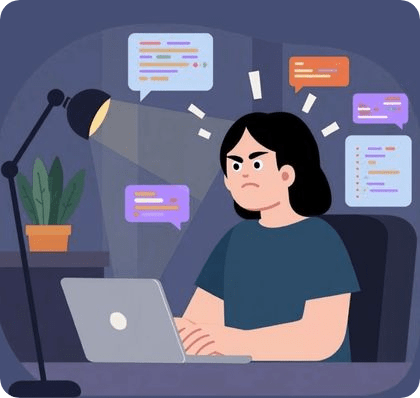
We have all had that moment where a conversation ends, and everything feels completely normal. Nothing weird, nothing dramatic — just a regular social interaction we forget about instantly. But then, later in the day, or especially at night, our brain suddenly brings it back like it is urgent business. We start replaying what we said, how we said it, and how the other person reacted, hunting for something that might have gone wrong. The strange part is that most of the time, nothing actually did. It only feels like it did once our minds start overanalyzing it.
This is a very common experience, especially in a world where we are constantly talking, texting, and interacting. Our brains are always processing social moments, even after they are over. Instead of letting them go, we hold on to them and turn them into mental reruns that trigger social anxiety. The real reason behind this is not the conversation itself, but how certain moments quietly trigger emotions and thoughts we do not always notice. Learning how to stop overthinking these moments starts with understanding why our brain does this in the first place.
Read More: Why We Feel Emotionally Heavy Without Realizing It
Why Our Brain Keeps Replaying Every Social Interaction
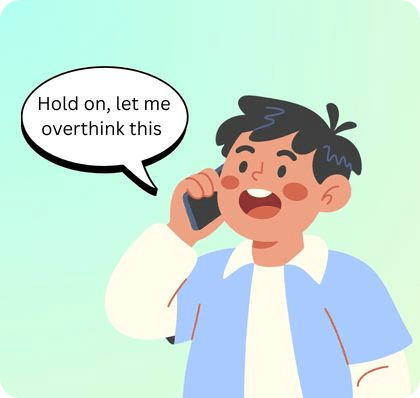
Replaying conversations is closely linked to overthinking. Our brain craves closure, and when it does not feel completely sure about a social interaction, it tries to “solve” it by replaying the moment again and again. We think about what we said, whether it sounded right, and how the other person might have taken it. It feels productive, like we are fixing something. In reality, we are just circling the same thoughts without getting anywhere new — falling straight into the trap of cognitive rumination.
This happens because we care about how we are seen by others. Even if we do not realize it, we want to come across as well-liked. So when a conversation ends, our brain sometimes goes into review mode, checking for mistakes or missed cues. The problem is that this review is not objective. It is shaped by insecurity, self-doubt, and small worries that grow bigger in our heads over time.
Read More: How to Manage Anxiety as a Teen: 5 Best Techniques
How Cognitive Rumination Creates Stories That Were Never There
One of the biggest reasons we stay stuck in mental replays is that our minds hate uncertainty. If something feels unclear, we try to fill in the gaps. A short reply might feel like disinterest. A neutral expression might feel like judgment. But most of these interpretations are guesses, not facts — a classic sign of cognitive rumination taking over.
The mind prefers stories over silence, so it creates meaning even when there is none. This is how a simple social interaction slowly turns into a full narrative in our head. The story we build is usually more negative than reality. We assume the worst because our brain is trying to protect us from rejection or embarrassment, even when there is no real threat — and that protective instinct is exactly what fuels social anxiety.
Why Overthinking and Social Anxiety Feel Stronger at Night
Many people notice that overthinking and social anxiety become worse at night. This is because there are fewer distractions, and the mind finally has space to process everything from the day. Without noise, scrolling, or conversations to pull us away, our thoughts become louder.
This is when old conversations resurface. Things we did not care about earlier suddenly feel important. The mind starts replaying them in detail, even if nothing significant happened. It is not that the moments changed — it is that our attention has nowhere else to go, so it turns inward.
How to Stop Overthinking and Calm Social Anxiety
The truth is, most conversations we replay are not as important as they feel in our heads. Other people are usually not analyzing us the way we think they are. They are busy with their own thoughts, their own worries, and their own lives. What feels like a big moment to us is often a small moment they have already moved on from.
Learning how to stop overthinking does not happen overnight, but it does get easier once we stop treating every replay as meaningful. Instead, we can recognize it as just a mental habit. Some people find it helpful to write their thoughts down, reflect without judgment, or use simple tools to understand their emotional triggers.
Apps like Simpli Human can also help track these patterns and make sense of why certain moments stay with us longer than others. At the end of the day, the goal is not to control every thought — it is to stop overthinking a single conversation and stop letting it take up more space than it deserves.
FAQs
Because your brain hates leaving things unresolved. When a conversation ends and you’re not 100% sure how it went, your mind keeps going back to it trying to “figure it out.” It feels like you’re being productive but you’re really just going in circles.
At night when everything goes quiet, it finally has room to bring up all the stuff it was holding onto. That’s why a conversation you barely thought about at 2pm can feel like a crisis at midnight.
Because your brain isn’t checking whether things went well, it’s checking whether there’s any chance they didn’t. Even a totally normal conversation can trigger a replay if there was even one moment of uncertainty. It’s not logical, it’s just a habit your brain has developed.
The first step is just noticing it’s happening and reminding yourself it’s a habit, not a warning sign. From there, writing it down helps a lot — getting it out of your head and onto an app like Simpli Human makes it easier to see how small it actually is. The more you practice this, the faster the loop breaks.
Surprisingly yes. When you start logging how you feel after social situations, you begin to notice patterns, like certain times of day, specific people, or types of conversations that trigger the loop more than others. Once you can see the pattern, it loses a lot of its power. That’s exactly what Simpli Human’s mood tracking and journaling features are built for